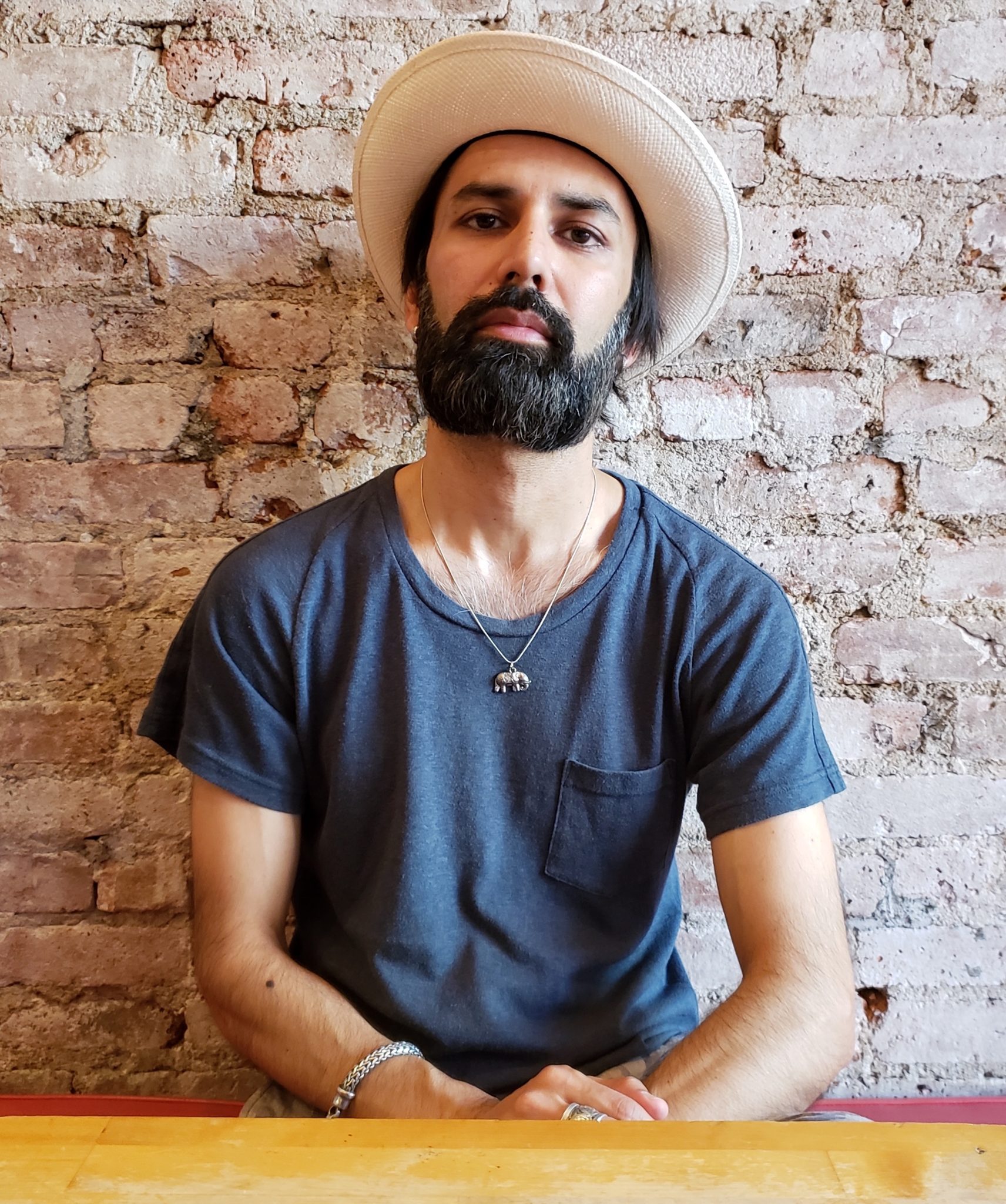
A man with “the most balanced brain hemispheres I’ve ever encountered,” as one client remarked, Faisal Azam is truly a man of many talents—as creative as he is analytical, as sensitive as he is critical, as intuitive as he is logical. Cultural omnivore, published writer, designer, dapper gentleman, and even a bit musically inclined (he plays the Oud, though he’ll admit he’s no virtuoso), Faisal is shockingly bright and possibly the hippest film geek you’ll ever meet.
Born in Karachi, Pakistan, Faisal grew up in the UAE and Saudi Arabia, and came to the United States at age 15 to complete his education. Soon finding himself suspended a bit uncomfortably between cultures and conflicting world views, Faisal had a lot to reconcile within himself by the time he got to college. With an intellectually ambitious plan to master a process of thinking that would allow him to evaluate and synthesize divergent perspectives, Faisal pursued the study of Rhetoric at UC Berkeley—one of the few universities with an entire department devoted to this age-old art.
Graduating magna cum laude with a B.A. in Rhetoric and a plethora of Eastern Studies courses under his academic belt, Faisal gained exposure to a broad and diverse range of thought—from Urdu poetry to postmodern cultural theory. By getting more attuned to South Asian, Arab and American cultures while training simultaneously in a predominantly Western approach to textual analysis and communication arts, Faisal began to understand his identity not simply as that of a multicultural Asian-American, but as a kind of “hyphen” who inhabits a fascinating interstitial space between East and West, tradition and innovation, intuition and reason.
Though his education helped him sort out his personal identity and harmonize philosophical dissonance, it left him with more questions than answers regarding his career options. One college course, however, shed a bit of light on his future path. In “Political Cinema,” a class taught by acclaimed film theorist Kaja Silverman and German avant-garde filmmaker Harun Farocki, Faisal came to fully appreciate the power of film as an artistic medium and incomparable communicative tool. From politics and race to sexuality and gender identity, Faisal saw how effectively filmmakers could challenge assumptions and influence perceptions. “No other medium has the power to move people so viscerally, to make them think, feel, question,” he says. “Before I took Political Cinema, I thought film was just for entertainment. Of course, I still believe a good film should be enjoyable, but it can be—and must be—so much more.”
Intrigued as he was by the communicative power of cinema, Faisal did not start his career in film but as an advertising communications analyst, entering the media realm from the outside looking in. Based in Los Angeles, Faisal evaluated television commercials and marketing campaigns for global brands like Ralston Purina, Procter & Gamble, Campbell Soup, Vanguard, Hennessy, Nestle and Oral B. Valued for his incisive analytical skills, deep comprehension of branding and marketing strategy, and a talent for articulating his insights with eloquence and ease, Faisal provided blue chip clients with the feedback they needed to improve the efficacy of their campaigns. As he studied hundreds of print, television and early internet ads during the 90s tech revolution, Faisal’s appreciation for the power of image-based media grew, rekindling his desire to explore what he considered the ultimate communicative medium—film.
Inspired by the French filmmaker Alain Resnais, who began his career as an editor and went on to achieve success as a director, Faisal decided to focus his attention on editing, which would place him, he felt, “at the very nexus of all the creative disciplines that constitute filmmaking.” Abandoning the world of corporate advertising for a day job at Starbucks and some side work tinkering with student films, Faisal realized he had an innate talent for the alchemy of filmic storytelling. Yet, looking back over the grand narrative of his life, his attraction to storytelling is really no surprise.
“My earliest cognition of editing occurred at the age of 8 in, of all places, Saudi Arabia, where television shows are heavily censored to remove even the slightest reference to sexuality.” Aware of the inexplicable gaps that disrupted love scenes and rendered stories virtually incoherent, Faisal became curious about the “missing parts” and was soon preoccupied by a secret wish to soften the brutality of these jarring cuts. “An editor is like a magician,” Faisal explains, “who remains more or less invisible but exercises tremendous influence on a film. I’ve always felt that film editing is very close to music composition because an editor manipulates time and deals with intangible things like tone, rhythm and pacing, all of which are felt on an unconscious level and exert an undeniably powerful influence on the viewer. When an audience laughs or cries—the power doesn’t just come from the story, the image or the performance, but from the way that various elements are combined, layered and juxtaposed.”
Embarking on a new career path at age 30, Faisal felt he didn’t have time to apprentice for years in the Hollywood system just to get a crack at editing. And so, with little more than an instinctive love of cinema and strong aesthetic sensibilities, he moved to New York City in 2004 to bootstrap his way into film. Finding opportunity as a freelancer, Faisal’s first projects were more fixer-uppers than masterpieces. But rather than bemoan the obligatory “dues paying,” he saw opportunity: “You can learn a lot more from a bad film than a good one sometimes; the mistakes are obvious, the methods of production not well concealed. In a way, you get a better sense of how films are made and, believe me, as an editor, it requires a lot of ingenuity to improve a story that isn’t working or camouflage glaring production errors in post.”
With a keen sense of narrative structure and a deep understanding of storytelling as a precise and exacting art, Faisal has gone on to attract high profile clients like Nike, Consumer Reports, Academy Award winning director Zana Briski, and Rolling Stone. Experienced with a variety of film forms—from commercials and promos to documentaries and narrative films—Faisal has successfully integrated his editing skills with his knowledge of filmmaking, advertising and branding, and general expertise in communication. Transcending the ordinary role of an editor, he directs, produces, writes, consults, designs, and coordinates talent as well—essentially doing whatever it takes to create content that is entertaining, thought-provoking and faithful to the client’s objectives.
To see Faisal’s film work, visit www.faisalazam.com
Bio written by Erica Velis. To see more of her work, visit www.ericavelis.com